

The Platform You Build vs. The Platform You Buy
If you just read our comparison with Pymetrics, you already know half this story. Pymetrics, the neuroscience-based hiring tool built by a Harvard/MIT scientist, was acquired by Harver in August 2022. To understand what that meant for Pymetrics, we had to understand what Harver actually is.
Turns out, that’s a more interesting question than it sounds.
Harver isn’t a product that grew into a platform. It’s a private equity acquisition strategy that assembled a platform out of purchased parts. The company that calls itself Harver today started as something called Outmatch, backed by Rubicon Technology Partners and Camden Partners. It completed seven acquisitions in four years, took the name of one of the companies it bought, and now markets the assembled pieces as a “comprehensive volume hiring solution.” It has had three CEOs since 2021.
None of that means Harver’s tools don’t work. They have 1,300+ customers, including McDonald’s, Booking.com, and Valvoline. They’ve processed 100 million candidates. The I/O psychology underpinning their assessments is rooted in 35 years of data. That’s real.
But there’s a difference between a platform that was built with a coherent vision and one that was assembled through acquisitions to create a comprehensive-looking product line. That difference shows up in the product, the experience, and if Glassdoor reviews from their own employees are any indication, the trajectory.
The Acquisition Timeline
Understanding what Harver is requires understanding how it was assembled. This isn’t ancient history — the entire construction happened in under four years.
March 2020
Rubicon Technology Partners acquires majority stake in Outmatch
Outmatch is a Saratoga Springs, NY-based “talent decision management platform” founded by Greg Moran. Rubicon, a Colorado-based PE firm, takes a controlling position alongside existing investor Camden Partners. The acquisition spree begins.
January 2019 – November 2020
Four acquisitions in under two years
WePow (video interviewing, Jan 2019) → LaunchPad (recruitment automation, Sep 2020) → FurstPerson (contact center pre-hire simulations, Oct 2020) → Checkster (automated reference checking, Nov 2020). Each acquisition adds a module to the “Talent Decision Platform.”
May 2021
Outmatch acquires Harver
Outmatch buys Harver, an Amsterdam-based volume-hiring platform. Combined: 1,300 customers, 25 million candidates screened per year, 250 employees across six offices. The two companies begin integration.
November 2021
Outmatch rebrands as Harver
The acquiring company takes the name of the company it acquired. Outmatch decides “Harver” has better market recognition and rebrands everything. US headquarters stays in Dallas. EMEA headquarters in Amsterdam.
January 2022
New CEO: Scott Landers replaces Greg Moran
Landers, previously CEO of Monotype (a font technology company), is brought in as CEO and Board Chair. Moran, Outmatch’s founder, moves to the board. Landers brings Steve Martin from Monotype as CTO.
August 2022
Harver acquires Pymetrics
Pymetrics — the neuroscience gaming platform founded by a Harvard/MIT neuroscientist, Forbes AI 50 company, $60M raised — becomes a product line inside Harver. Frida Polli goes from CEO to Chief Data Science Officer. Acquisition number seven.
March 2024
New CEO: Steve Martin replaces Scott Landers
Martin, who came from Monotype with Landers, takes over as CEO. Landers becomes a “board advisor.” That’s three CEOs in three years — Moran, Landers, Martin.
October 2024
Scott Landers departs entirely
Landers is announced as CEO of Achievers, an employee recognition platform. His Harver tenure — two years as CEO, seven months as board advisor — ends. In the announcement, his Harver role is described in past tense.
That’s seven acquisitions, three CEOs, one rebrand, and a name borrowed from an acquired company: all in four years. The original Harver was an Amsterdam startup founded by Barend Raaff. The company called “Harver” today is a Dallas-based PE portfolio company wearing an Amsterdam brand.
What Harver Actually Offers
Harver markets itself as an end-to-end volume hiring solution. To understand the product, it helps to understand which acquisition each piece came from.
Each of these tools has genuine capability. I/O psychology-validated assessments are real. The Pymetrics neuroscience games are peer-reviewed. Checkster actually does automate reference checking. The question isn’t whether individual pieces work. The question is whether an assembled platform behaves like a coherent product, and whether the roadmap serves the tools or the portfolio strategy.
Where SageScreen Fits: A Different Category

Harver is a pre-screening assessment platform. SageScreen is an AI interviewing platform. These are different things, and it matters to be precise about the distinction.
Harver’s tools sit before the interview in the hiring funnel. They filter, sort, and rank. After Harver does its work, someone still has to interview the candidates who passed. SageScreen is the interview, the part where a candidate’s competency, communication, and judgment are actually evaluated.
The Video Interview Problem
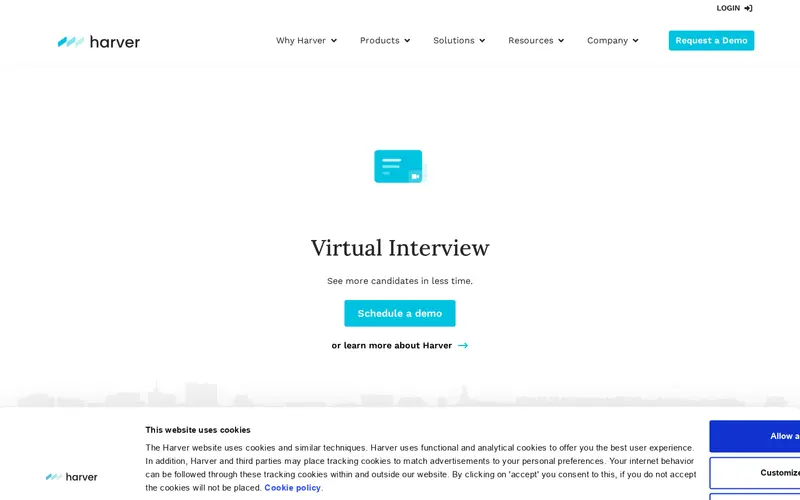
Harver does include a “virtual interview” module, which is where the category overlap gets confusing. But Harver’s own documentation describes it clearly: it’s a one-way, asynchronous video recording tool. Candidates record answers to preset questions. Recruiters watch the recordings later. There is no AI evaluation, no adaptive follow-up, no automated scoring of responses.
Harver’s knowledge base is explicit: their video interview module “does not make use of automated decision-making or facial and/or micro-expression analysis technology.” It’s a qualitative supplement to their quantitative assessment data; a way for recruiters to get a sense of candidates before committing to a live interview. It is not, by Harver’s own definition, meant to replace the face-to-face interview.
Harver “Virtual Interview”
Format: One-way recorded video. Candidate records answers to preset questions at their convenience.
Evaluation: Human recruiters watch recordings and manually score responses on a rating scale.
Follow-up: None. Questions are preset. No adaptation based on candidate responses.
Output: Video recordings for recruiter review. Manual scores averaged across raters.
Replaces: Phone screening. Explicitly not intended to replace face-to-face interviews.
SageScreen Interview
Format: Adaptive conversational interview. AI Sage asks questions and follows up based on responses.
Evaluation: 10 specialized AI agents across 3 isolated pipelines evaluate against company-defined rubrics.
Follow-up: Dynamic. The Sage probes for specifics, asks for examples, and adapts the conversation in real time.
Output: Full transcript, rubric-mapped competency scores with cited evidence, structured evaluation report.
Replaces: The first-round behavioral interview. The evaluation itself, not just the screening before it.
This isn’t a criticism of Harver’s video tool for what it’s designed to do — replacing phone screens with asynchronous video is a reasonable efficiency gain. But it’s not the same category as an AI that conducts and evaluates an actual interview. The gap between “record a video for someone to watch later” and “have an adaptive conversation that produces a structured evaluation” is the gap between a voicemail and a phone call.
What Harver Produces vs. What SageScreen Produces
The most practical comparison is output. What does the hiring team actually receive?
What Harver Delivers
Assessment Scores + Video Recordings
Match Score
Aggregate candidate-to-role fit score based on assessment results, behavioral games, and cognitive tests
Assessment Data
Individual scores across cognitive ability, personality traits, situational judgment, and gamified behavioral assessments
Video Clips
Recorded candidate responses to preset questions — reviewable by recruiters, scored manually
The hiring team gets data to inform who to interview, plus video clips to preview candidates. But the actual evaluation — the structured assessment of whether this person can do this job — still happens in a human-led interview that Harver doesn’t conduct.
What SageScreen Delivers
A Complete Interview Evaluation
Full Transcript
The complete adaptive behavioral interview — every question, every follow-up, every candidate response
Rubric Scores
Competency ratings mapped to company-defined criteria with specific evidence cited from the conversation
Actionable Report
Structured evaluation the hiring manager can act on, challenge, or override — with evidence for every score
The hiring team receives a complete behavioral assessment. They don’t need to conduct another interview to evaluate competency — the Sage already did, and the evidence is on the page.
The Built vs. Bought Architecture

Assembled platforms face a structural challenge: each acquired module was built for a different purpose, by a different team, with a different technical architecture. Integration is possible but never seamless. The seams show up in candidate experience (different interfaces for different assessment modules), in data flow (results that don’t naturally connect across tools), and in roadmap priority (which acquired module gets engineering attention this quarter?).
SageScreen was built as a single system from the start. The 10 AI agents across 3 isolated pipelines, conversation, evaluation, and reporting, were designed to work together. The conversation engine doesn’t know the score. The scoring engine doesn’t influence the questions. The report generator draws from both but can’t modify either. These aren’t acquired tools stitched together; they’re a single architecture with deliberate separation of concerns.
Harver: Assembled Architecture
7 acquisitions integrated into a shared platform
Each module built by a different team with different priorities
Integration through ATS connectors and shared dashboards
Roadmap governed by PE portfolio optimization
3 CEOs in 3 years setting product direction
SageScreen: Purpose-Built Architecture
Single system designed from first principles
One team, one vision, one technical architecture
3 isolated pipelines with deliberate separation of concerns
Roadmap governed by product vision, not portfolio strategy
Reusable Sage architecture designed to survive organizational change
The Pricing Comparison
Harver does not publish pricing. Third-party sources indicate an annual starting point of around $5,000 with custom enterprise quotes based on assessment volume and product bundle. Implementations involve I/O psychologist consultations, ATS integrations, and multi-week onboarding processes. This is enterprise software priced and sold like enterprise software.
Who Should Use Which
Consider Harver If:
✓ You’re hiring at massive scale — thousands of hourly or entry-level roles per quarter
✓ You want a comprehensive pre-screening suite: assessments, video recording, scheduling, and reference checking in one platform
✓ Your candidates have limited work experience and need to be assessed on cognitive traits and personality fit
✓ You have the budget and implementation runway for enterprise software ($5K+ annually, multi-week setup)
✓ You have recruiters available to review video recordings and conduct the actual interviews
Consider SageScreen If:
✓ You want AI to conduct the interview, not just filter candidates before one
✓ Your roles require demonstrated behavioral competency — communication, judgment, situational reasoning
✓ Your hiring team needs auditable evidence for every score, not just aggregate match percentages
✓ You want to be operational in minutes, not weeks
✓ Transparent, published pricing matters to you
✓ You’d rather buy a focused tool that does one thing well than a bundled suite assembled from acquisitions
The Pattern and the Alternative

Harver is the third company in this blog series that follows the PE acquisition pattern. Modern Hire, the science-first interview platform, was acquired by HireVue in 2023. Pymetrics was absorbed by Harver in 2022. And Harver itself is the product of seven acquisitions assembled by Rubicon Technology Partners.
The pattern repeats because it works — for the investors. PE firms buy specialized tools, bundle them into “platforms,” sell comprehensive solutions to enterprise procurement teams, and create entities that look impressive in a capabilities matrix. The tools get maintained. Customers get served. But the original innovation in each acquired company becomes a line item in someone else’s feature list, and the roadmap bends toward whatever makes the portfolio more valuable at exit.
SageScreen was built as one thing: an AI interviewing platform that conducts adaptive behavioral interviews and produces evaluations hiring teams can trust. We’re not assembling a suite. We’re not buying our way into adjacent categories. We’re not optimizing for a capabilities checkbox that makes an enterprise buyer feel like they got everything in one contract.
We’re building a product that does one thing well enough that the one thing is worth choosing on its own.
The Bottom Line
Harver is a real company with real customers solving real problems in volume hiring. The I/O psychology behind their assessments is validated. The neuroscience from Pymetrics is genuine. The reference checking works. If you’re a BPO or contact center hiring 5,000 people a quarter and you want a single platform that filters candidates before your recruiting team interviews them, Harver is a credible option.
But if you’re looking for AI that actually conducts interviews, that talks to candidates, follows up, evaluates competency, and produces evidence, you’re looking at a different category. Harver’s “interview” is a recording booth. SageScreen’s interview is a conversation with a purpose.
And if the stability of the platform you build on matters, if you want to know that the product will be the same product in two years, not an integration target, it’s worth looking at who’s building versus who’s buying.