

The Interviewer vs. The Scheduler
If you’re reading this, you probably searched for something like “AI hiring tools” or “AI screening software” and found both Paradox and SageScreen in the results. That makes sense. Both companies use AI in hiring. Both automate parts of the process that used to require a human. Both promise to save time.
But they solve fundamentally different problems. Paradox — built around its AI assistant Olivia — automates the logistics around hiring: scheduling interviews, answering candidate FAQs, sending reminders, collecting basic qualifications. SageScreen automates the judgment inside hiring: conducting adaptive behavioral interviews, evaluating competency against custom rubrics, and producing structured reports that tell hiring teams what they actually need to know about a candidate.
This isn’t a head-to-head comparison because they aren’t head-to-head products. It’s a guide to understanding where each tool sits in your hiring funnel — and why, if you came here looking for AI that can actually screen candidates, you’re in the right place.
Where Each Tool Lives in the Funnel
The simplest way to understand the difference is to look at where each tool does its work:
1. Candidate Applies
Both platforms can engage here — Paradox via career site chat, SageScreen via invitation link
2. Initial Qualification
Paradox shines here. Olivia asks knockout questions via text: “Are you 18+? Do you have reliable transportation? Are you available weekends?” Yes/no filtering at scale.
3. Interview Scheduling
Paradox shines here. Calendar sync, multi-timezone coordination, automated reminders, rescheduling via SMS. This is Paradox’s core competency.
4. Candidate Screening
SageScreen lives here. Adaptive AI interviews that evaluate behavioral competency, cultural fit, communication skills, and role-specific knowledge against a custom rubric. 15–60+ minutes of real conversation.
5. Evaluation & Report
SageScreen lives here. Independent evaluation pipeline scores the transcript. Structured report with rubric-mapped evidence, fraud indicators, and full transcript delivered to the hiring team.
6. Hiring Decision
Both tools hand off to your human hiring team for final decisions
Paradox handles steps 2 and 3 exceptionally well. SageScreen handles steps 4 and 5. They overlap at the edges, but the core work is different. One automates the process around the interview. The other is the interview.
What Paradox Does Well
Credit where it’s earned. Paradox has become one of the most successful HR tech companies of the past decade, and for good reason. Founded in 2016 by Aaron Matos in Scottsdale, Arizona, the company built a conversational AI assistant named Olivia that handles the parts of recruiting that eat recruiters alive: scheduling, rescheduling, reminders, FAQ responses, knockout screening, and candidate communication across 100+ languages.
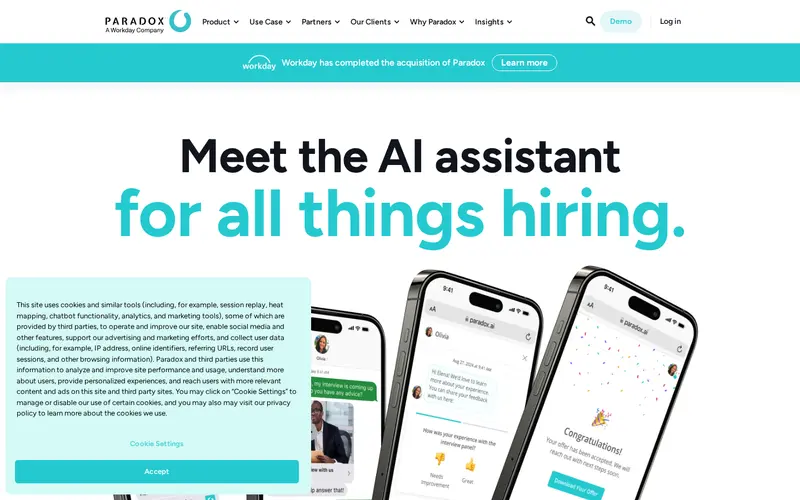
The numbers are real. Paradox facilitated roughly 189 million AI-assisted candidate conversations before its acquisition. It schedules an estimated 32 million interviews annually — roughly one in every ten interviews in the United States. Clients like Chipotle reported reducing time-to-hire from 12 days to 4. GM saved an estimated $2 million annually in recruiter time. The Deloitte Fast 500 named Paradox the fastest-growing HR tech company four consecutive years.
If your hiring bottleneck is logistics — if your recruiters are drowning in scheduling emails, if candidates are ghosting because nobody responded for a week, if you need to process thousands of frontline applicants through basic qualification checks — Paradox was purpose-built for that.
Where the Confusion Starts
The challenge is that “AI screening” means two very different things depending on who’s saying it.
When Paradox says screening, they mean qualification filtering. Olivia asks a set of predefined questions — Are you authorized to work in this country? Do you have a valid license? Can you lift 50 pounds? — and routes candidates based on their answers. It’s fast, it’s efficient, and for high-volume frontline roles where the primary question is “does this person meet the minimum requirements,” it works.
When SageScreen says screening, we mean conducting an actual interview. A 15-to-60-minute adaptive conversation where the AI asks behavioral questions tailored to the specific role, follows up based on the candidate’s answers, probes for depth when responses are vague, and produces a structured evaluation against a custom rubric. This is the work that a trained human interviewer does — the part that actually tells you whether someone can do the job, not just whether they meet the minimum qualifications to be considered.
“Qualification filtering tells you who’s eligible. Screening tells you who’s capable. They’re different questions with different tools.”
Side by Side: What Each Tool Actually Does
Rather than a traditional comparison table, here’s a walkthrough of what happens when a candidate encounters each platform:
The Workday Factor
In October 2025, Workday completed its acquisition of Paradox for $1 billion in cash. Paradox is now the “Workday Paradox Candidate Experience Agent,” sitting alongside HiredScore (AI talent discovery, acquired 2024), Sana Labs (AI-powered search, acquired 2025), and Workday Recruiting in a unified talent acquisition suite.
This is relevant for two reasons.
First, Paradox’s roadmap is now Workday’s roadmap. Product decisions, integration priorities, and feature development are governed by a $60+ billion enterprise platform company’s strategic priorities. Industry analyst Josh Bersin noted that this deal was about expanding Workday into the frontline worker market and deepening its AI agent portfolio — not necessarily about making Paradox’s hiring automation better for the companies already using it.
Second, it means Paradox is now part of an enterprise ERP ecosystem. If you’re a Workday shop, that’s convenient. If you’re not, you’re buying a tool whose deepest integrations and strongest product investment will increasingly favor the platform that owns it. Founder Aaron Matos stepped down as CEO in March 2024. The company that built Olivia is now a division of the company that builds your payroll software.
SageScreen is independent, self-funded, and platform-agnostic. No PE investors. No acquisition roadmap. No ERP parent company deciding what gets built next. The product exists to solve one problem — AI-powered candidate screening — and that’s where all investment goes.
The Architecture Gap
Paradox was built as a conversational chatbot — a very good one — that routes candidates through predefined workflows. It’s a logistics engine. The AI’s job is to manage the conversation toward a scheduling outcome, answer questions from a knowledge base, and filter candidates through qualification gates. When Olivia encounters something she can’t handle, she routes it to a human. Multiple reviews note that the AI can loop on complex questions or provide incomplete answers on nuanced topics.
This isn’t a weakness. It’s a design choice. Paradox was never designed to evaluate competency. It was designed to get candidates to the point where a human could evaluate them.
SageScreen was designed for the evaluation itself. The platform uses ten specialized AI agents across three isolated pipelines. One pipeline manages the interview conversation: adaptive questioning, follow-up logic, and rubric maintenance working together. A second pipeline receives the cold transcript after the interview ends and evaluates it independently — agents that were never part of the conversation applying the rubric from scratch. A third handles the broader role lifecycle: fraud analysis, scoring calibration, and report generation.
This separation exists because the science demands it. The agents that build rapport with a candidate should never influence the agents that assess their competency. The agents that manage conversational flow should never contaminate the agents measuring rubric alignment. Paradox doesn’t need this architecture because it doesn’t do evaluation. SageScreen does.
SageScreen’s Pipeline Isolation — Why It Matters
Interview Pipeline
Adaptive questioning, conversational flow, follow-up logic, rubric maintenance. Conducts the conversation.
Evaluation Pipeline
Cold transcript review, rubric scoring, evidence mapping. Never saw the live interview. Clean, unbiased judgment.
Role Lifecycle Pipeline
Fraud analysis, scoring calibration, report generation. Ensures integrity across the full screening cycle.
Who Should Use Which
This is the section most comparison articles skip. We’re not going to pretend SageScreen is the right tool for every hiring problem. Here’s an honest breakdown:
Use Paradox if…
You’re hiring thousands of frontline workers and your bottleneck is scheduling and logistics
Your screening needs are primarily qualification-based (yes/no questions)
You’re a Workday customer and want native integration with your existing HCM stack
You need to automate candidate communication, reminders, and FAQ responses at scale
Use SageScreen if…
You need AI that can actually evaluate candidates — not just filter them
Your screening requires behavioral assessment, cultural fit, or nuanced competency evaluation
You’re hiring for roles where the interview itself is the screening mechanism, not just a gate to one
You want structured, evidence-based reports — not just a qualified/not-qualified flag
You need multilingual AI interviews with configurable voices in 30 languages — not just translated text messages
You want a platform-agnostic tool that isn’t owned by your ERP vendor
Can You Use Both?
Yes. And for some organizations, that’s the right answer.
Paradox is excellent at getting candidates from “applied” to “qualified and scheduled.” SageScreen is excellent at getting candidates from “qualified” to “evaluated with evidence.” If you’re processing thousands of frontline applicants per month and you need both fast logistics and meaningful evaluation, the two tools serve consecutive steps in the same funnel.
Paradox handles intake, qualifies, schedules. SageScreen sends a Sage to conduct the interview, evaluates independently, delivers the structured report. Your hiring team reviews candidates who’ve been both qualified and screened, with evidence in hand. The entire process from application to evaluated candidate happens without a human touching the logistics or conducting the first-round interview.
That said, many SageScreen customers don’t need Paradox at all. If you’re not processing thousands of frontline applicants, the logistics problem Paradox solves may not be your bottleneck. Your bottleneck might be: “We don’t have enough time or people to screen the 50 candidates who applied this week.” That’s the problem SageScreen was built to solve.
The Transparency Question
One design difference worth highlighting: how each tool presents itself to candidates.
Olivia uses the founder’s wife’s photograph as the chatbot profile picture. The AI is programmed to feel like a real person responding, and multiple reviews describe the experience as feeling like “texting a friend.” Paradox has stated that the goal is a “human touch” in their automation. The assistant has a woman’s name, a real woman’s face, and is deliberately designed to make candidates forget they’re talking to software.
SageScreen takes the opposite approach. The AI identifies itself as AI from the first message. There’s no avatar, no photograph of a real person, no attempt to simulate human presence. Candidates know what they’re interacting with. We believe this is a matter of professional respect — and increasingly, it’s becoming a matter of compliance. As Pew Research has documented, public skepticism about AI in hiring is high. Building trust starts with honesty about what you are.
Pricing and Access
Paradox does not publish pricing. All accounts require a sales conversation, and user reports suggest the platform is priced for enterprise-scale deployments. Multiple reviewers note that the cost can be difficult to justify for organizations hiring fewer than 100 people per year. Now that Paradox is a Workday product, pricing and packaging may continue to evolve within Workday’s enterprise licensing model.
SageScreen uses transparent, credit-based pricing. Buy credits, configure a reusable AI interviewer (called a Sage), and deploy it to as many candidates as you need. No minimums. No annual contracts. No sales calls required. A ten-person company pays the same per-interview rate as a ten-thousand-person company.
The Bottom Line
Paradox is a legitimately excellent product that earned its $1 billion acquisition price by solving a real, painful problem — the logistical nightmare of high-volume recruiting. If your recruiters are spending half their day on scheduling emails and your candidates are dropping off because nobody responded for a week, Paradox is built for that.
But if you searched for “AI screening” hoping to find a tool that can actually interview candidates — one that asks intelligent questions, adapts in real time, evaluates competency against a structured rubric, and delivers a report your hiring team can trust — that’s a different problem. Paradox wasn’t designed for it. SageScreen was.
The recruiter’s assistant and the hiring team’s interviewer. Both useful. Both AI. Not the same thing at all.
Ready to see what AI screening actually looks like?
Not scheduling. Not chatbots. Real adaptive interviews that produce real evaluations.