
AI Candidate Screening
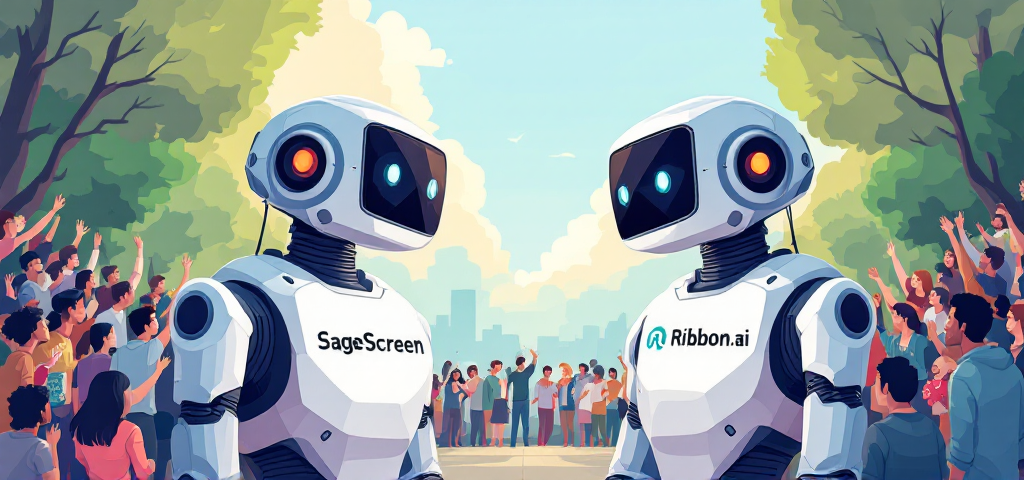
Two startups. Both founded in the 2020s. Both built AI-first. Both claim to fix what’s broken about hiring.
So why do they feel nothing alike when you actually use them?
Ribbon.ai launched to general availability in March 2025 with $8.2 million in backing from Radical Ventures, positioning itself as the AI recruiter that replaces the phone screen. They’ve landed nearly 400 customers across manufacturing, airports, restaurants, and logistics. Their pitch: voice AI that conducts first-round interviews 24/7 so recruiters never have to schedule another screening call.
SageScreen launched in December 2025 with a different thesis entirely. Instead of replacing the recruiter’s phone screen, we replaced the static interview altogether. The process starts with intake: the platform reads the job description, then collects context from the hiring team through a short form covering company culture, role expectations, preferred interview language, and whether to assess English proficiency. From there, every role gets a custom AI interviewer, a Sage, powered by three separate agents working in concert to conduct the conversation. A completely independent evaluation pipeline of four additional agents, none of which were present during the interview, applies the rubric and produces the report. No scores. No rankings. Full audit trail.
Both platforms are new. Neither has legacy baggage. This isn’t David and Goliath. It’s two fundamentally different answers to the same question: what should AI actually do during a hiring screen?
The Quick Comparison
The grid is useful. But the real differences aren’t in the rows. They’re in what each platform assumes about the relationship between speed, depth, and trust.
Philosophy First: Speed vs Depth
Ribbon’s entire value proposition is built around velocity. Their co-founder Arsham Ghahramani, formerly of Amazon AI, has described the vision as making hiring as frictionless as ordering coffee. Five-minute voice screens. Bulk candidate links. Thousands of interviews overnight. The platform rewards throughput, and it does it well. If your hiring problem is “we physically cannot schedule enough phone screens,” Ribbon addresses that directly.
SageScreen’s value proposition is built around the quality of the conversation itself. A behavioral screen runs 15 to 25 minutes. An advanced technical screen, where the Sage asks coding questions, probes systems architecture decisions, and evaluates how a candidate reasons through design tradeoffs, can run over an hour. Follow-up questions probe the specifics of what someone actually said, not the next item on a list. The Sage doesn’t rush because the architecture wasn’t designed around compression. It was designed around the idea that a five-minute screen might tell you whether someone can string a sentence together, but it won’t tell you how they handle ambiguity, conflict, or the moment things go sideways.
Optimized for rapid pass/fail. Get through the queue. Move the pipeline. The question is what you can learn about someone in five minutes that you didn’t already know from their resume.
Behavioral screens run 15–25 minutes. Advanced technical screens, where the Sage asks coding, architecture, and systems design questions, can run over an hour. The depth scales with the role. See what a Sage covers →
Neither approach is wrong in the abstract. But they serve fundamentally different definitions of what “screening” means. For Ribbon, screening means triage. For SageScreen, screening means evaluation. One answers “should we talk to this person?” The other answers “here’s what this person is actually like in context.”
The Question Bank Problem
This is where the philosophical difference becomes a mechanical one.
Ribbon auto-generates interview questions from a job description. The recruiter can customize them. But once they’re set, every candidate for that role gets some version of the same set. The AI adapts conversationally (asking follow-ups, allowing do-overs), but the core question structure is predetermined. That’s an interview flow. It’s efficient, repeatable, and consistent.
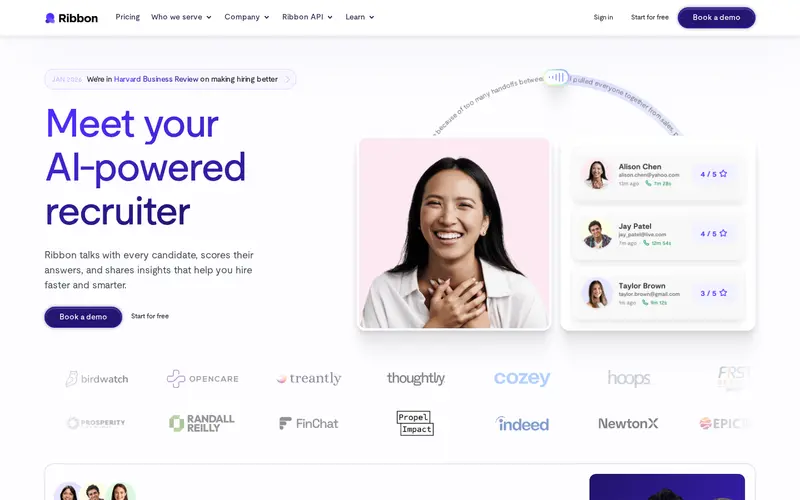
It also means that anyone who’s done a Ribbon interview for a similar role has a pretty good idea of what’s coming. And in an era where candidates share interview questions on Reddit, Glassdoor, and TikTok within hours, a static question set has a half-life measured in days.
SageScreen doesn’t use question banks at all. Before the first interview happens, the platform ingests the job description and collects context from the hiring team through a short intake form: company culture, role-specific expectations, preferred interview language, and whether to test for English proficiency. The Sage then generates every question dynamically during the conversation itself, guided by the rubric, the intake context, and the candidate’s actual responses. If a candidate mentions managing a cross-functional conflict, the Sage follows that thread. If they pivot to discussing process improvement, the Sage adapts. No two interviews are identical, even for the same role, because no two candidates say the same things.
Why does this matter?
🎯 Anti-Gaming
When every interview is unique, preparation means developing real skills, not memorizing answers. The Sage rewards authenticity because rehearsed responses don’t map to adaptive questions.
🔍 Signal Quality
Static questions produce comparable answers. Dynamic questions produce revealing ones. When you follow a candidate’s actual thinking, you learn what a checklist never surfaces.
⚖️ Fairness
Fixed questions can inadvertently favor candidates from specific backgrounds who’ve encountered those exact scenarios. Adaptive questioning meets every candidate where they are.
Ribbon’s approach works well for roles where you need consistent, high-volume pass/fail decisions. Warehouse associate. Line cook. Parking attendant. The question is whether “did they answer five standard questions acceptably” is sufficient signal for every role in your organization, or just some of them.
Architecture: One AI vs Seven
This is the structural difference most people miss, and it’s the one that matters most.
Ribbon uses a single AI system. It conducts the interview, listens to the responses, scores the answers, generates a summary, and produces candidate rankings. That’s efficient. It’s also what most AI interview platforms do, because building one model is simpler than building many.
The problem is that the same system forming impressions during the conversation is the one making the evaluation after it. If the AI notices hesitation in a candidate’s voice on question two, that impression colors how it interprets question five. If a candidate starts strong and fades, the AI’s summary reflects the arc, not just the content. This is the same reason human interviewers have bias. First impressions anchor everything that follows.
SageScreen uses seven separate AI agents, and the separation is the point. Three agents work together to conduct the interview: managing the conversation flow, adapting questions to the candidate’s responses, and maintaining the behavioral rubric. They guide, probe, and follow threads, but they never score. They never summarize. Their only job is to produce a rich, authentic transcript.
Then four completely independent agents handle the evaluation. They receive the transcript cold. They weren’t present during the conversation. They have no impressions, no momentum, no anchoring from how the candidate sounded or how the conversation felt. They read the evidence on paper and judge the evidence on paper, each responsible for distinct dimensions of the assessment.
Why seven agents instead of one? Because AI grounding, the process by which a model stays anchored to its task and context, degrades when you overload a single model with competing objectives. An agent that’s simultaneously trying to be warm and conversational while also clinically evaluating responses is grounded in neither role fully. The conversational context bleeds into the evaluation. The evaluative stance bleeds into the conversation. You get an AI that’s mediocre at both instead of excellent at each.
Separating interview from evaluation, and further separating agents within each phase, keeps every agent’s grounding clean. The interviewing agents stay grounded in the conversation. The evaluation agents stay grounded in the rubric. No cross-contamination. No accumulated bias. No single model trying to be everything at once and doing none of it well.
This isn’t a criticism of Ribbon specifically. Nearly every AI screening platform on the market uses a single-model approach. It’s the industry default because it’s cheaper, faster, and easier to ship. But cheaper architecture isn’t neutral architecture. As regulatory frameworks like New York City’s Local Law 144 require independent bias audits of automated hiring tools, and state-level AI hiring laws proliferate across the country, the structural question of how your AI reaches its conclusions isn’t theoretical anymore. It’s a compliance question. And when a federal court allows discrimination claims to proceed against an AI hiring tool vendor, the question of whether your architecture can explain itself becomes a legal one.
Scores, Rankings, and the Illusion of Objectivity
Ribbon produces candidate scores and rankings. Their platform is built around the idea that recruiters need a shortlist, and the fastest way to generate a shortlist is to put everyone on a scale. The recruiter sees who’s at the top, reviews those candidates first, and moves faster.
There’s nothing dishonest about this. It’s exactly what the platform advertises. The issue isn’t deception. It’s anchoring.
When a recruiter sees that Candidate A scored 4.2 and Candidate B scored 3.7, the decision is already being shaped before the recruiter reads a single word of context. Tversky and Kahneman’s foundational research on anchoring demonstrated this decades ago: numerical anchors influence judgment even when people know the numbers are arbitrary. And when those scores come from an AI tool that falls under emerging automated decision tool regulations, the question of how the number was generated becomes more than academic. The anchoring effect is amplified, not diminished.
SageScreen doesn’t produce scores. There are no rankings, no percentiles, and no comparative metrics between candidates. The output is a structured evaluation: the candidate either demonstrated alignment with the role expectations or they didn’t, with specific transcript evidence cited for each dimension of the rubric. A recruiter reviewing the report reads what the candidate said, not what a number says about what the candidate said.
Every SageScreen evaluation can be traced from rubric to transcript to assessment. The recruiter doesn’t trust a score. They verify a conclusion. That’s the difference between automation and augmentation.
The Candidate Experience Question
Both platforms care about candidate experience, and both can point to evidence that they deliver it. Ribbon cites 95% of candidates rating their interview experience 5 out of 5 stars. That’s impressive, and it aligns with their design philosophy: make it fast, make it convenient, make it feel human.
Both platforms are available 24/7. Both support multilingual interviews. Both let candidates screen at midnight in their pajamas if that’s when works best. Neither requires scheduling a phone call during business hours. On the operational basics of accessibility, the platforms converge.
Where they diverge is in what “candidate experience” actually means once the interview starts.
Ribbon optimizes for brevity. A five-minute voice screen that’s fast, polite, and over before the candidate has time to get nervous. That’s genuine comfort, and for high-volume roles where candidates are applying to dozens of positions, respecting their time is real.
SageScreen optimizes for dignity. Candidates are told upfront that AI is involved, how the process works, and what data is used. The conversation itself is long enough for the candidate to actually demonstrate depth: 15 minutes for a behavioral screen, over an hour for advanced technical roles where the Sage asks coding and architecture questions. And because there are no scores, no one is reduced to a number they’ll never see and can’t contest. The evaluation describes what happened in the conversation. Not what an algorithm inferred about who they are.
Both platforms deliver convenience. The difference is what happens with the time. Ribbon keeps it short. SageScreen uses it to learn something a resume can’t tell you.
Pricing and Accessibility
Ribbon’s pricing starts at $499 per month for the Growth plan (2 seats, 2 interview flows, 200 interviews) and scales to $999 per month for Business (5 seats, 5 flows, 500 interviews). After you exceed your plan’s interview limit, each additional interview costs $3. Enterprise pricing is custom. ATS integration is locked to the Business tier and above. That means the features most mid-size companies need (integration with their existing hiring stack) require a thousand-dollar monthly commitment before a single interview happens.
SageScreen uses credit-based pricing that scales with actual usage. No monthly seat fees. No tiered feature gates. No requirement to predict your interview volume three months in advance. You buy credits, you use them, you buy more when you need them. The platform’s full feature set is available from the first credit.
Ribbon Growth (200 interviews)
$499/mo
+ $3 per overage interview
Ribbon Business (500 interviews)
$999/mo
ATS integration starts here
SageScreen
Credits
Full features. No tiers. No gates.
The pricing models reflect the same philosophical split. Ribbon’s model assumes predictable, high-volume hiring with monthly commitments. SageScreen’s model assumes that hiring is unpredictable, and the tool should flex with you instead of billing you for capacity you didn’t use.
What Ribbon Does Well
It would be easy to write a comparison that only highlights differences in SageScreen’s favor. That’s not what this is.
Ribbon’s voice AI is genuinely impressive. Candidates consistently describe it as natural, conversational, and surprisingly human. The voice-first approach feels different from a text-based interview, and for roles where verbal communication is core to the job, hearing a candidate speak has value.
Their ATS integration ecosystem (45+ platforms including Workday, Lever, and Greenhouse) is mature for a company their age. The white-label option for agencies and enterprise clients is thoughtful. And their candidate-side tools, including resume analysis, interview prep, and a job search copilot, show a genuine investment in the other side of the hiring equation.
Some capabilities that Ribbon highlights are shared ground between the platforms. Both offer 24/7 availability and multilingual support. Both handle bulk screening: SageScreen lets you upload a CSV and handles all the invitations and follow-up nudges automatically, no manual outreach required. Both eliminate the scheduling bottleneck entirely. These aren’t differentiators between the two platforms. They’re table stakes for any modern AI screening tool.
Where Ribbon genuinely differentiates is in voice-first delivery and the breadth of their ATS connector library. If your hiring stack runs on Workday or Greenhouse and you need plug-and-play integration today, that matters.
Where We Think Differently
The differences come down to three convictions that shaped how SageScreen was built.
First: the AI that interviews should not be the AI that judges. This is SageScreen’s architectural line in the sand. Ribbon’s single-model approach is efficient, but efficiency and impartiality are different goals. When the same system builds rapport and renders verdicts, you get a process that feels fair but may not be structurally fair. SageScreen uses seven agents across two completely separate pipelines because the separation is what makes the evaluation auditable, and what keeps every agent’s grounding clean.
Second: scores create the illusion of objectivity. The moment you attach a number to a candidate, the human reviewer stops reading and starts comparing. SageScreen produces evaluations that require the recruiter to engage with the substance: what the candidate said, what it means in context, and whether it aligns with the role. That takes more effort than scanning a leaderboard. That’s intentional.
Third: five minutes isn’t enough for roles that require judgment. Ribbon’s speed-first model serves high-volume, high-turnover hiring extremely well. But behavioral screening, the kind that surfaces how someone thinks, adapts, and handles complexity, requires conversational depth that a five-minute voice call can’t provide. And for technical roles, where you need to know whether a candidate can reason through architecture decisions or debug a system under pressure, you need a Sage that can spend an hour going deep on code, systems design, and tradeoff analysis. SageScreen was built for roles where the cost of a bad hire isn’t a two-week training cycle. It’s six months of team disruption.
The Verdict (There Isn’t One)
There’s no single right answer here, because these platforms aren’t competing for the same use case.
If you’re a staffing agency filling 200 warehouse positions next month, or a restaurant chain onboarding seasonal staff across 40 locations, Ribbon’s speed and scale are built for that reality. The five-minute screen, the bulk link, the 24/7 multilingual voice AI: that’s a real product solving a real problem at a real price point.
If you’re hiring for roles where the interview is supposed to reveal something, where you need to understand how someone thinks and not just whether they can answer five questions, and where the regulatory and reputational cost of an opaque process is measured in lawsuits rather than turnover, SageScreen was designed for that world.
Some organizations need both. High-volume triage for frontline roles and behavioral depth for positions where the stakes are higher. That’s a legitimate stack.
The question isn’t which platform is better. It’s which question you’re actually trying to answer about your candidates, and whether your screening tool is architecturally capable of answering it honestly.