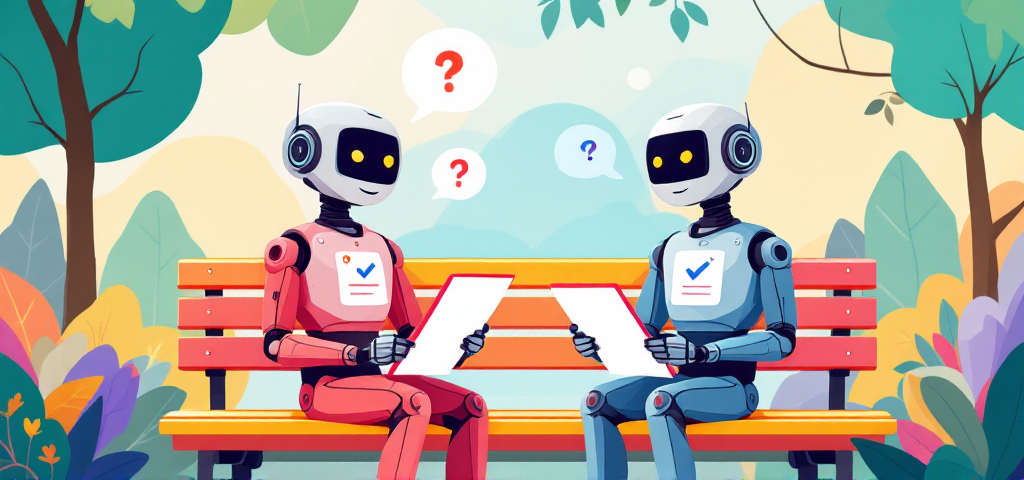

Tests Measure Skills. Interviews Reveal People.
Unlike most of the companies we’ve compared to SageScreen — companies that have been acquired, absorbed into PE-backed conglomerates, or quietly dissolved — Canditech is still an independent company. It’s a VC-backed Israeli startup, founded in 2019, that hasn’t been rolled up into someone else’s platform yet. That alone distinguishes it in a market where independence is increasingly rare.
What it does, however, is fundamentally different from what SageScreen does. And the difference isn’t cosmetic. It’s structural — rooted in what each platform believes a hiring process should actually measure.
Canditech is a skill assessment platform. It gives candidates tests. SageScreen is a behavioral interview platform. It gives candidates conversations. Those two approaches answer different questions about a candidate, produce different kinds of evidence, and expose different failure modes. Understanding the distinction matters — because choosing the wrong tool for the wrong question is how companies end up with people who pass every test and fail every collaboration.
What Canditech Actually Is
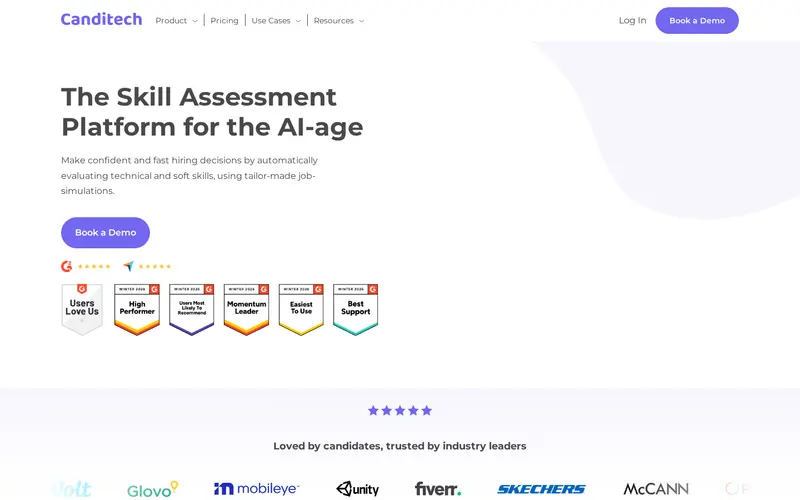
Canditech was founded in 2019 in Tel Aviv and raised a $9 million seed round from Insight Partners and StageOne Ventures in 2022. It’s a small company — fewer than 50 employees — operating on a single round of venture funding with no disclosed follow-on. Its tagline is “create a world without resumes,” and its approach to that goal is replacing resume screening with standardized skill testing. That’s a real improvement over resume-first hiring. The question is whether it’s a sufficient improvement.
The platform’s core offering is a library of over 500 pre-built assessments — and that number is presented as a selling point, but it’s worth examining what it actually means. “Pre-built” means generic. It means the “Data Analyst” test your company sends to candidates is the same “Data Analyst” test that hundreds of other Canditech customers are sending to theirs. The questions aren’t shaped by your tech stack, your team’s workflow, or the specific problems your analyst will actually encounter on day one. They’re shaped by Canditech’s content team’s idea of what a data analyst generically does. Canditech does let companies customize assessments or build their own, but the core value proposition — the thing that saves time — is the pre-built library. And “pre-built for everyone” is another way of saying “built for no one in particular.”
The platform also includes one-way video interviews (candidates record responses to pre-set questions), a recruitment chatbot for WhatsApp/SMS pre-screening, and custom branding for the test interface. It’s a feature-rich testing toolkit. But the breadth of features masks a narrowness of capability — every piece of it is built around the same fundamental interaction model: present the candidate with a prompt, collect a static response, score it after the fact. That model has limits, and those limits are where SageScreen begins.
Compare that to SageScreen’s model: every Sage is configured for a specific role at your specific company. A Sage interviewing for a Customer Success Manager at a SaaS company asks different questions — and probes different behavioral dimensions — than a Sage interviewing for a Customer Success Manager at a logistics firm. The interview isn’t pulled from a library. It’s shaped by what the role actually requires. And because the Sage adapts in real time to each candidate’s responses, no two interviews are identical even for the same position.
None of this is the problem with Canditech’s execution. The execution is fine. The problem is what testing — any testing — structurally cannot do.
The Fundamental Category Difference
Canditech and SageScreen look superficially similar if you squint. Both are AI-powered. Both sit early in the hiring funnel. Both aim to help you make better decisions before the live interview. But they approach that goal from opposite directions, and the data they produce is categorically different.
This isn’t a quality difference. It’s a category difference. Canditech tells you whether someone can write a SQL query. SageScreen tells you how someone navigates a situation where the right query depends on constraints they have to uncover through questioning. One measures knowledge. The other measures the application of judgment.
The Format Problem: Why Tests Are Structurally Gameable
Every testing platform — Canditech included — invests heavily in anti-cheating infrastructure. Detection tools, proctoring measures, randomization. These are industry-standard capabilities, and any serious assessment platform uses them. That’s not a criticism of Canditech specifically. It’s a criticism of the format.
The reason testing platforms need elaborate integrity measures is that tests are inherently gameable. The answers exist independently of the candidate. A correct SQL query is a correct SQL query regardless of who typed it — or where they found it. The test can’t tell whether the candidate reasoned through the problem or copied it from a second screen, a friend on a call, or an AI tool running on a different device. So the platform has to build an entire surveillance layer to proxy for something it can never truly verify: that the person taking the test is actually the one doing the thinking.
This isn’t about whether one platform has better proctoring than the other. It’s about whether the format itself is resistant to the kinds of gaming that matter. In a conversation, you can’t pre-script an answer because the follow-up question depends on what you just said. You can’t outsource the thinking because the Sage will probe the specifics of your experience, your decisions, your reasoning. The dynamic nature of the interaction is the integrity mechanism. It doesn’t need to be bolted on — it’s woven into how conversations work.
This is the structural advantage of conversation over testing. A test asks “do you know the answer?” A conversation asks “can you think through the problem?” — and keeps asking until the depth of the candidate’s understanding is clear, one way or the other.
What “AI-Powered” Actually Means in Each Platform
Both Canditech and SageScreen use AI. But they use it at fundamentally different points in the process, and the difference matters more than most buyers realize.
In Canditech, AI bookends the experience: it helps build the test, and it scores the completed test. But the test itself — the part the candidate actually encounters — is static. Every candidate who takes the same assessment gets the same questions in the same order (randomized, perhaps, but from a fixed pool). The AI never responds to what the candidate says. It processes answers after they’ve been submitted.
In SageScreen, AI is the experience. The Sage — your reusable AI interviewer — conducts a live behavioral interview, listening to each response and adapting its follow-up questions accordingly. If a candidate gives a vague answer, the Sage probes. If a candidate reveals an interesting decision point, the Sage explores it. The AI isn’t just scoring. It’s interviewing. And the output reflects that — narrative evaluations with specific quotes from the conversation, not numerical scores from a rubric.
This distinction has a practical consequence that matters more than it might seem: two candidates who receive the same Canditech test will have identical experiences. Two candidates who sit with the same SageScreen Sage will have completely different conversations — because the Sage responds to who they actually are.
The One-Way Video Problem
Canditech includes one-way video interviews alongside its testing toolkit. On the surface, this looks like it bridges the gap between testing and interviewing. Candidates see a question prompt, record a video response, and move on. Hiring managers review the videos later and rate them.
But one-way video isn’t an interview. It’s a performance recording with no feedback loop. The candidate talks into a void. There’s no follow-up. No clarification. No “tell me more about that.” No moment where the interviewer picks up on something subtle and pursues it. The candidate has one shot to guess what the evaluator wants to hear, and the evaluator watches a recording that captures none of the dynamic interplay that makes interviews useful in the first place.
One-way video is also notoriously unpopular with candidates. It combines the stress of being recorded with the awkwardness of talking to nobody. SageScreen’s approach — a text-based conversation with an AI that actually responds — eliminates both problems. The candidate writes naturally, the Sage responds thoughtfully, and the result is a transcript that reads like a real conversation because it is one.
The Auto-Scoring Black Box
Canditech touts AI auto-scoring as a key efficiency feature: pre-trained AI agents check and score candidate answers, and companies can build their own custom scoring agents. The pitch is speed — no more manual review of every open-text response.
But speed without transparency creates a different problem. When an AI scores a test answer, what’s the rubric? When it rejects a candidate’s response as insufficient, what evidence supports that judgment? When a hiring manager looks at a scored assessment, how do they validate whether the scoring was fair, accurate, or aligned with what they actually care about?
SageScreen’s evaluations are narratives with receipts. Every assessment is tied to specific things the candidate said during the conversation. A hiring manager can read the evaluation, check it against the transcript, and form their own judgment. The AI doesn’t just score — it shows its work. That transparency is what makes the output useful in a hiring decision rather than just a gate to pass through.
Canditech Says It Out Loud
To their credit, Canditech is honest about what they’re not. Their own FAQ on their homepage asks and answers the question directly:
From Canditech’s own FAQ:
“Is Canditech an interview replacement?”
“No, Canditech doesn’t replace interviews, it makes them count.”
That’s a fair answer. But it raises an obvious follow-up question: what if a platform could replace interviews — or at least conduct them with enough depth and rigor that the live interview becomes a confirmation rather than a discovery?
Canditech explicitly positions itself as a pre-interview filter. It helps you identify which candidates are worth talking to. SageScreen is the talking-to part. That’s not a weakness on either side — it’s a genuine difference in purpose. The question is whether, in 2026, a static testing platform and a live interview platform are competing with each other, or whether the interview layer is what most companies are actually missing.
Here’s the case for the latter: most companies don’t struggle to determine whether a candidate can write JavaScript. They have code tests for that. They have technical phone screens. They have GitHub profiles. What they struggle with is determining whether a candidate communicates well under pressure, navigates ambiguity, takes ownership, collaborates effectively, and exercises good judgment when the answer isn’t in a textbook. Those are the things that determine whether someone succeeds in a role — and they’re the things no test can measure, no matter how sophisticated the scoring AI.
Pricing: Opacity vs. Transparency
Canditech offers four tiers — Individual, Team, Pro, and Enterprise — but doesn’t publish actual pricing on its website. You get a feature comparison grid. You do not get dollar amounts. To know what Canditech costs, you have to book a demo or start a free trial and then ask. The feature gating is also notable: cheating prevention tools, dedicated account management, and PhD-level psychometric support are reserved for higher tiers. The full platform is meaningfully different from the entry-level offering.
SageScreen’s pricing is published. One credit, one interview. Credits range from $18 at baseline to lower per-credit costs at volume. There are no hidden tiers, no feature gating based on plan level, no “contact sales to learn what this actually costs.” Every customer gets the same Sage capabilities, the same evaluation depth, and the same transparent output. You know what you’ll spend before you start.
When Canditech Makes Sense (and When It Doesn’t)
We don’t think Canditech is a bad product. We think it’s a good product for a specific job — and that job isn’t what SageScreen does.
Could you use both? Sure — Canditech to verify someone can write a query, SageScreen to find out whether they can explain their reasoning, collaborate under pressure, and exercise judgment when the requirements are ambiguous. But if you have to choose one, ask yourself which problem your hiring process is actually failing at. Most companies don’t lose good hires because they couldn’t verify SQL syntax. They lose them because they never understood how the candidate thinks.
The Deeper Question
The hiring technology industry has spent a decade building increasingly sophisticated ways to test candidates — more question types, more proctoring tools, more AI scoring, more gamified cognitive challenges. The implicit assumption behind all of it is that hiring is fundamentally a measurement problem: if we can just measure candidates precisely enough, we’ll know who to hire.
But anyone who’s actually managed a team knows that the best test-takers aren’t always the best employees. The people who thrive in organizations are the ones who communicate clearly, ask good questions, adapt to ambiguity, take responsibility when things go wrong, and make the people around them better. Those qualities don’t show up on a skills assessment, no matter how sophisticated the scoring engine behind it.
Canditech is on the right side of a real trend — skills-based hiring is better than resume-based hiring, full stop. Measuring what someone can do is more equitable and more predictive than measuring where they went to school. We agree with that premise entirely. Where we diverge is on the idea that measuring skills is sufficient. It’s necessary but not nearly enough.
SageScreen exists for the layer Canditech openly says it doesn’t address: the conversation. The part where you stop measuring what a candidate knows and start understanding who they are.
If you want to verify skills, test them. Canditech does that well. If you want to understand people, talk to them. That’s what we built for.