

Organizational decay rarely shows up with drama. It arrives quietly, usually while everyone is busy being extremely productive. A missing step here. An undocumented decision there. A role that evolves through folklore instead of documentation. Eventually the entire operation begins drifting into a shape nobody intended but everyone tolerates.
Entropy is not a leadership failure. Entropy is physics. Order takes intention. Disorder requires no effort at all.
This becomes especially entertaining when companies start plugging AI into their workflows. Leadership imagines AI will tidy up their processes, reveal hidden order, and solve a decade of accumulated ambiguity. Instead AI does something far more honest. It magnifies whatever structure is already present. If your environment has clarity, AI accelerates it. If your environment is a fog of improvisation, AI amplifies the fog.
Organizational theory has been explaining this for years (source). Most companies simply prefer not to listen.
The Slow Drift of Organizational Entropy
Entropy does not arrive as a crisis. It arrives as drift. Alignment erodes one small decision at a time. Communication becomes slightly less precise. Ownership becomes slightly more questionable. A process that once made sense slowly becomes optional. No single moment feels significant until, at scale, everything feels unpredictable.
Teams compensate. They invent personal workarounds. They rely on intuition when structure is missing. They remember how things used to work and assume the memory is still accurate. This improvisation quietly becomes the operating model.
Eventually someone asks the dreaded question. When did we start doing it this way. The silence after that question is entropy taking a bow.
AI does not correct that trajectory. Harvard Business Review has pointed out that AI initiatives fail not due to technical limitations but due to organizational misalignment and unclear ownership (source). You cannot fix drift by adding speed. You only reach the wall faster.
AI as an Entropy Amplifier
People want AI to impose order. They imagine an algorithm stepping in as a kind of corporate referee. They believe automation will patch the cracks left by years of process neglect. But AI is not a designer. AI is an amplifier.
Give AI a stable process and it scales it.
Give AI an inconsistent process and it broadcasts the inconsistency.
Research into AI supported business processes shows the same pattern. Well structured environments get meaningful acceleration. Poorly structured environments get erratic output and performance instability (source).
AI does not introduce chaos. It accelerates the chaos already present.
Which brings us to design, the very unglamorous but entirely necessary discipline most organizations skip.
Why Organizational Design Matters More Than Anyone Admits

Design is not decoration. It is the architecture that determines how information flows, how decisions propagate, and how consistency is preserved when nobody is looking. Leadership teams often assume people will fill in the gaps. People usually do, but not in the same way, and certainly not forever.
Business process orientation research continues to demonstrate that organizations with deliberate process design outperform those that rely on improvisation (source). This is predictable. Clear systems behave predictably. Ambiguous systems behave however they feel that day.
Ignoring design is essentially inviting entropy to run your company.
This becomes painfully obvious in one area: hiring.
Hiring Is Entropy’s Favorite Playground
If you want to evaluate the health of an organization, inspect the hiring process. You will see entropy in its purest form.
Different interviewers ask different questions. They evaluate answers through their own mental frameworks. They remember the rubric loosely or ignore it entirely. Candidates sift through a lottery of personalities rather than a consistent evaluation system. A candidate rejected by one interviewer might be hired immediately by another, not because the candidate changed, but because the interviewer did.
This is drift. This is entropy. This is what happens when design is missing.
AI does not magically stabilize this. It cannot smooth chaos into order. Studies on AI supported evaluation show that consistent inputs produce consistent AI output. Inconsistent inputs produce untrustworthy signals, only faster and with a straight face (source).
Hiring without design eventually infects everything downstream.
This is where SageScreen enters the story, not as a gadget, but as a countermeasure.
How SageScreen Puts Design Back Into Hiring
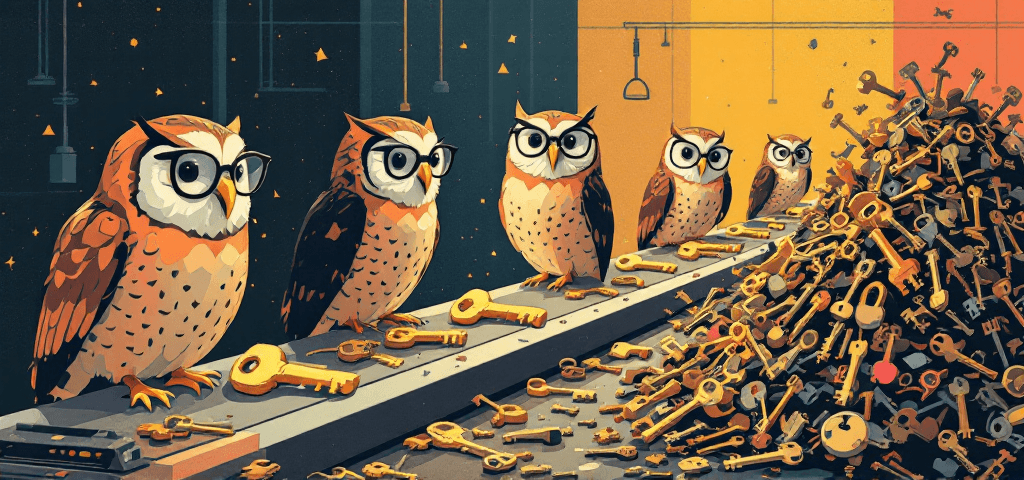
SageScreen treats interviewing as a system. Not as a conversation. Not as a performance. Not as a coin toss conducted by whoever had the least chaotic morning.
A Sage is a designed evaluator. You capture the expertise once. You capture the expectations once. You define success once. The Sage repeats that standard for every candidate, with the same structure, the same logic, and the same evaluation boundaries.
Humans drift constantly. Sages do not.
The SageScreen design prevents interviewers from accidentally reinventing the process. It eliminates the slow erosion of standards. It resists the entropy that usually destroys consistency long before leadership realizes what happened.
Candidates are evaluated on reasoning, judgment, communication, and alignment using the same architecture every time. It is reliable. It is auditable. It is the opposite of drift.
This is why SageScreen works. It is not because the AI is magical. It is because the system is designed.
AI Works Best When the System Works First
This is the entire point. AI succeeds when the underlying structure is sound. It fails noisily when the structure is missing. When organizations treat AI like a hero, they eventually discover the hero needs a script. When organizations treat AI like a multiplier of a well designed system, they finally get the transformation they hoped for.
Hiring is the first function where entropy shows up and the last place companies think to design. SageScreen solves the structural problem, not the symptom.
When the evaluation system is coherent, AI becomes coherent.
When the evaluation system is drifting, AI becomes unpredictable.
Once again, this is not theory. This is how systems behave.
Why SageScreen Is the Structural Answer, Not the Shortcut

Many AI hiring tools promise shortcuts. SageScreen does not. SageScreen is architecture. It is design. It is the foundation that keeps the entire hiring process from dissolving into what it inevitably becomes without structure.
If entropy is the problem, design is the solution.
If drift is the threat, consistency is the defense.
If AI is the accelerator, the system had better be stable first.
SageScreen gives hiring the structural backbone it has been missing. It prevents drift. It preserves clarity. It delivers consistent evaluation. It gives AI something solid to amplify rather than something chaotic to distort.
Organizations fall apart without design.
With SageScreen, at least one critical system in your company does not.