

When Hiring Is the Product vs. When It’s a Side Effect
micro1 is one of the bigger names in AI-assisted hiring right now. A synthetic avatar named Zara who conducts interviews in 33 languages while monitoring candidates’ screens for signs of cheating. Over 400,000 AI interviews conducted. A client list that includes Deel and several Fortune 100 companies.
SageScreen launched in February 2025 with a fundamentally different set of opinions about how AI interviews should work.
This comparison is about what you’re actually buying when you buy an AI interviewer. micro1 built Zara to solve their own problem: screening enormous volumes of contract labor for AI training data projects. They then commercialized it. SageScreen was built from day one as a hiring-specific platform designed for companies whose screening decisions carry real consequence.
The architecture, the philosophy, and the candidate experience are fundamentally different. Here’s how.
At a Glance
| micro1 (Zara) | SageScreen | |
|---|---|---|
| Primary Business | AI training data marketplace; Zara is one product line | Purpose-built AI screening platform |
| Interview Format | Video + voice with synthetic avatar, 20–30 min | Voice & text adaptive conversation, 15–60+ min |
| AI Architecture | Single model (GPT-4o) for interview + evaluation | 10 specialized agents across 3 isolated pipelines |
| Output | Match scores, resume scores, proficiency ratings, video recording | Structured evaluation with transcript evidence and scores; candidates never ranked against each other |
| Candidate Data Use | May be used to train AI models per privacy policy | Interview data used only for evaluation; not used for AI training |
| Anti-Cheat | Full-screen monitoring, tab-switch detection, proctoring score | Dynamic unique questions per candidate + browser behavior, image heuristics, ambient sound profiling |
| Pricing | $89–$399/mo tiers + enterprise custom | Credit-based, pay per interview, no minimums |
The Origin Story Matters
micro1 was founded in 2022 as a marketplace connecting AI labs with human contractors for data labeling and RLHF tasks. Their CEO has described the core business as providing human data to frontier AI labs. Zara was built internally to screen the flood of contract applicants, then commercialized as a standalone product.
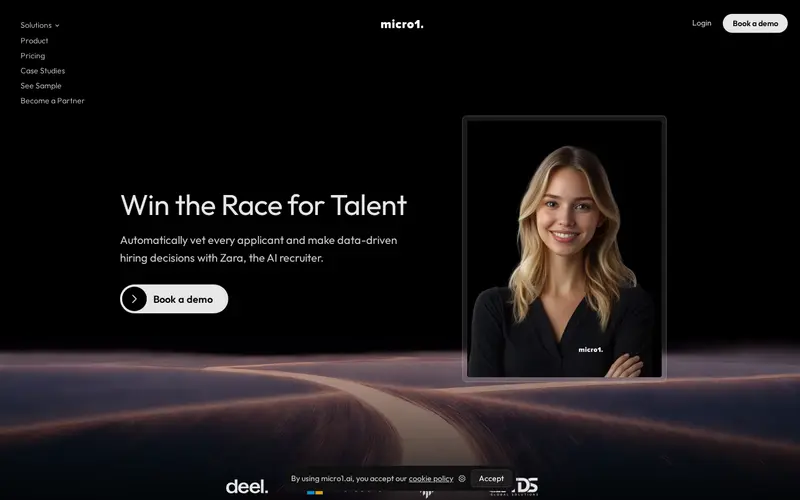
This matters because it shapes what the tool optimizes for. When your AI interviewer was born to screen thousands of gig workers per day for data labeling projects, it’s going to be very good at volume and speed. It’s going to be less concerned with the nuances of behavioral interviewing, cultural fit assessment, or producing evaluations that hold up under regulatory scrutiny, because those things weren’t part of the original design constraints.
SageScreen was designed from the ground up for a different problem: companies that need to screen candidates for roles where hiring decisions carry real weight. The entire architecture, from the multi-agent interview pipeline to the independent evaluation system to the transparency-first approach, was built for that purpose. Not adapted. Not bolted on. Built.
The Avatar Question
Zara’s most immediately visible differentiator is the synthetic avatar: a blonde, professional-looking woman who appears on screen during video interviews. The San Francisco Standard described her as having “shoulder-length blonde balayage, trusting glimmer in her eyes, and dimples on either side of a pearly-white smile.” micro1 initially used a male voice but switched to a female one after surveys showed candidates found it less intimidating.
This raises a design question that goes beyond aesthetics. When your AI interviewer has a synthetic face designed to make candidates feel comfortable, you’re making a deliberate choice to blur the line between human and machine interaction. micro1’s own CEO has acknowledged the tension: “We don’t want to present an AI system as a human.” But the avatar’s design suggests the opposite instinct.
SageScreen takes a different position entirely. Candidates know from the first moment that they’re interacting with AI. There’s no avatar, no synthetic face, no attempt to simulate a human presence. The interface is a text-based conversation, and the AI identifies itself clearly. We believe this is a matter of professional respect, not just disclosure compliance.
“71% of Americans oppose AI making final hiring decisions. 66% say they wouldn’t even apply to a job where AI helps with hiring. When public trust in AI screening is this fragile, the last thing you want is a synthetic face designed to make people forget they’re talking to a machine.”
— Pew Research Center, AI in Hiring and Evaluating Workers
Surveillance vs. Signal
micro1 takes cheating seriously, and their approach shows it. Zara requires full desktop screen sharing. The system flags tab switches, external monitor usage, and ChatGPT activity. A proctoring score is included in every candidate report. Video and audio of the entire interview are recorded and stored.
This is the surveillance model of anti-cheat. It works by watching what the candidate does around the interview. It assumes cheating will happen and builds infrastructure to detect it after the fact.
SageScreen approaches the problem from both directions. Because every interview starts with intake context, including the job description, company culture, role expectations, and language proficiency requirements, the Sage generates unique questions for every single candidate. Not random questions. Questions informed by what the hiring team actually cares about, adapted in real time based on how the candidate responds. There is no question bank to memorize. There’s nothing to look up on Reddit or share on Glassdoor, because the next candidate’s questions will be different.
SageScreen also tracks fraud signals across every interview: browser behavior anomalies, image heuristics, ambient sound profiling, and other behavioral indicators. The difference isn’t that we don’t monitor. It’s that we don’t make surveillance the centerpiece. Fraud data surfaces in every interview report for the hiring team, but the primary defense is architectural: when every question is unique and adaptive, the value of external help drops to near zero.
The anti-gaming protection isn’t a layer bolted onto the interview. It’s woven through the interview itself.
Neither approach is wrong. But one requires trusting the surveillance infrastructure. The other removes the need for it.
One AI vs. Ten
micro1’s published research confirms that Zara runs on GPT-4o in a single-model architecture. One model conducts the interview, evaluates performance, generates scores, and produces the candidate report. This is the industry standard. It’s fast, relatively cheap, and simple to deploy.
It also means the same model that’s trying to make a candidate feel comfortable is simultaneously scoring them. The same context window that’s managing conversational flow is also making judgments about technical competence. These are competing objectives, and AI models degrade in quality when you overload them with too many goals at once. The grounding contamination problem isn’t theoretical. It’s the reason large language models give worse answers when you ask them to do five things at once instead of one.
SageScreen uses ten specialized agents across three completely isolated pipelines that make up the full interview and role cycle. One pipeline manages the conversational interview itself: adaptive questioning, conversational flow, and rubric maintenance working in concert. When the interview ends, a separate evaluation pipeline receives the cold transcript, agents that were never part of the conversation applying the rubric from scratch. A third pipeline handles the broader role lifecycle, including fraud analysis, scoring calibration, and report generation.
The agents that heard the candidate’s nervous laugh at the beginning never influence the agents that assess their technical depth. The agents that built rapport never contaminate the agents measuring rubric alignment. This is deliberate architectural separation designed to prevent exactly the kind of cross-contamination that single-model systems can’t avoid.
Why does pipeline isolation matter?
No Halo Effect
A charming interview doesn’t inflate evaluation scores. Evaluation agents never saw the charm.
Clean Grounding
Each agent holds a single objective. No competing priorities degrading any agent’s output.
Full Audit Trail
Every evaluation decision traces back to specific transcript evidence. No black-box scoring.
Scores and Match Percentages
Zara produces an “AI Match Score” based on interview performance, an “Instant Resume Score” for job description alignment, and granular proficiency ratings for each skill tested. These numbers are presented as data points the hiring team can use to rank, sort, and filter candidates.
The problem with match scores and candidate rankings isn’t that numbers are useless. It’s that ranking candidates against each other is a fundamentally different act than evaluating them against the role. When a hiring manager sees that Candidate A scored 87% and Candidate B scored 72%, the conversation is already anchored. Decades of research in behavioral economics have demonstrated that numerical anchors shape downstream decisions even when people are told the numbers are arbitrary. Ranking turns an evaluation into a competition, and the AI’s confidence in the ranking becomes the hiring team’s confidence by proxy.
SageScreen produces scores. Each evaluation includes structured ratings against the rubric criteria the hiring team defined. But candidates are never ranked against each other. Every evaluation stands on its own: what this candidate demonstrated, measured against what the role requires. The evaluation pipeline produces a structured report that describes what happened in the conversation, where depth was demonstrated, where gaps appeared, and every claim links back to specific moments in the transcript.
Scores measured against a rubric give you signal. Rankings measured against other candidates give you a leaderboard. One informs a decision. The other makes the decision for you.
The Data Question
This is where the platforms diverge most sharply, and where origin stories matter most.
micro1’s candidate privacy notice states that anonymized interview data, including audio, video, transcripts, and assessment results, may be used to train machine learning models. It also states this data “may also be shared with foundational model providers (e.g., large language model companies) to help improve their underlying models.” For a company whose primary business is providing training data to AI labs, this creates a structural tension: the interview data your candidates generate may feed the same pipeline that powers micro1’s core revenue stream.
SageScreen’s architecture treats candidate interview data as exactly one thing: the basis for producing an evaluation for the hiring team. Interview data is not used to train models. It’s not shared with third-party AI providers. It’s not anonymized and fed into a data pipeline. The interview exists to serve the candidate and the hiring team. Full stop.
A question worth asking any AI hiring vendor:
Does the company that interviews your candidates also sell data services to AI labs? If yes, ask where the wall is between those two businesses. Then ask whether candidates are told. As state-level AI hiring regulations proliferate, the distinction between “interview tool” and “data collection pipeline” will increasingly have legal implications.
Candidate Experience: Performance vs. Conversation
micro1 has strong candidate satisfaction metrics. They report an NPS of 4.37 out of 5 and nearly 2,900 Trustpilot reviews with generally positive sentiment. Candidates frequently describe Zara as feeling “natural” and “surprisingly human.” The voice-first format works well for candidates who are strong verbal communicators, and the 20–30 minute interview length is respectful of people’s time.
But the interview is also a performance. Candidates sit in front of a camera, share their entire desktop, and speak to a synthetic face while being monitored for suspicious behavior. For some candidates, especially those who are less comfortable on camera, who interview better in writing, or who find surveillance anxiety-inducing, this format doesn’t surface their best signal. It surfaces their comfort with being watched.
SageScreen offers both voice and text. Candidates can speak to a configurable AI voice, available in 30 languages with options for gender, accent, and speaking style, or they can type. They can switch between the two mid-interview. The conversation runs 15 minutes for a focused behavioral screen and over an hour for advanced technical roles that include coding questions, architecture discussions, and systems design scenarios. There’s no synthetic face. No camera required. No desktop screen sharing. Both platforms are available 24/7 with multilingual support. Both handle bulk screening: SageScreen lets you upload a CSV and manages all invitations and follow-up nudges automatically. The operational convenience is shared. What differs is the philosophy: micro1 simulates a human interviewer as closely as possible. SageScreen makes the AI visible and lets the quality of the conversation speak for itself.
micro1
Video + voice with avatar. Desktop monitoring. 20–30 minutes. Optimized for verbal communicators.
SageScreen
Voice & text adaptive conversation. Configurable voices in 30 languages. 15–60+ minutes. Optimized for depth.
Both
24/7 availability. Multilingual. Bulk CSV upload. Automated invitations. No scheduling required.
Pricing
micro1’s pricing for the Zara AI Recruiter product is tiered. Third-party review sites list an Early Stage plan at $89/month and a Growth plan at approximately $399/month, which includes around 100 AI interviews, custom questions, multilingual support, and ATS integrations. Enterprise pricing is custom. For micro1’s talent marketplace services, where they source and place contract labor, costs are substantially higher and negotiated directly.
SageScreen uses credit-based pricing with no monthly minimums and no tiered feature gates. You buy credits, you use them, you buy more when you need them. Every feature on the platform is available from the first credit. There’s no entry-level plan that locks out language support or reporting depth.
Pricing Structure Comparison
micro1 (Zara)
$89 – $399+/mo
Monthly tiers. Feature gates between plans. ~100 interviews on Growth tier. Enterprise requires sales conversation.
SageScreen
Pay per credit
No monthly minimum. No feature tiers. Full platform access from credit one. Scale up or down with zero commitment.
The structural difference matters for organizations with variable hiring volumes. If you’re hiring ten people this quarter and forty next quarter, a monthly subscription means you’re either overpaying during quiet months or scrambling to upgrade during busy ones. Credit-based pricing matches your costs to your actual usage.
What micro1 Does Well
micro1’s scale is real. Conducting over 400,000 AI interviews and processing massive candidate volumes for clients like Deel is genuine operational proof. At that volume, the platform has encountered edge cases that smaller competitors haven’t, and the system has been hardened by real-world usage in ways that matter.
The voice-first format with a video avatar represents a genuine design bet. For candidates who interview better verbally, speaking to Zara may feel more natural than typing. The 33-language support is extensive, and the C1/C2 language certification feature addresses a real gap in cross-border hiring. The anti-cheat system, while philosophically different from SageScreen’s approach, catches real fraud in high-stakes technical assessments.
micro1’s candidate-facing features, including automated feedback delivery and a RAG-based system for answering candidate questions about the process, show investment in the other side of the equation. And their ATS integration ecosystem is maturing. For organizations that need high-velocity screening at massive scale, especially for contract or gig-economy roles, the throughput is compelling.
Where We Think Differently
We built SageScreen on three convictions that put us at odds with micro1’s approach.
A hiring tool should serve hiring. Nothing else.
When the company that interviews your candidates also sells data to AI labs, there’s a structural incentive to collect more data than the hiring decision requires. SageScreen collects what the evaluation needs and nothing more. Your candidates’ interview data isn’t a byproduct feeding another business line.
Architecture first. Surveillance second.
We monitor fraud signals too: browser behavior, image heuristics, ambient sound profiling. Every interview report includes them. But monitoring catches cheaters after they cheat. Dynamic, unique questions per candidate eliminate the opportunity to cheat in the first place. We do both, but we lead with the one that scales.
AI should be honest about being AI.
Synthetic avatars optimized for approachability work against the transparency that candidates deserve. When two-thirds of Americans already don’t want to apply where AI is involved, building trust requires clarity about what you are. Not a digital face designed to make them forget.
The Verdict
micro1 is an impressive company doing legitimate work at real scale. Zara has screened hundreds of thousands of candidates, and the platform has earned its position in the market, particularly for organizations that need high-volume, high-velocity screening for contract, gig, or technical roles where the primary question is “can this person do the thing.”
But the platform was born as internal tooling for a data company, and that origin shows. The synthetic avatar, the surveillance-centered proctoring, the interview data flowing into AI training pipelines, the single-model architecture producing ranked match scores: these are features optimized for throughput, not for the kind of careful, transparent, defensible screening that regulatory frameworks are increasingly demanding.
If your primary bottleneck is screening volume and your candidates are largely applying for contract or technical roles where a 20-minute video assessment is sufficient signal, micro1 is a serious tool with serious operational proof behind it.
If you need an AI interview that adapts to each candidate individually, that separates conversation from judgment architecturally, that produces evaluations your hiring team can actually interrogate, and that treats candidate data as something to protect rather than something to monetize, that’s what we built SageScreen to do.
Different tools. Different DNA. Choose the one that matches what you’re actually trying to learn about your candidates.